ON-DEVICE PROCESSING
Acoustic analysis is designed to happen locally on participating devices.
Distributed gunshot detection using the smartphones already in your community. RoundSift helps participating devices detect, corroborate and locate potential firearm discharges—without installing a traditional sensor network.
On-device processing • No continuous audio upload • Peer corroboration • No continuous location tracking
Participating smartphones can act as independent witnesses, allowing coverage to grow with participation.
Pilot requests route to our partnerships team. We scope the deployment together — defined area, measurement plan, and a contract that grows only after the numbers hold up.
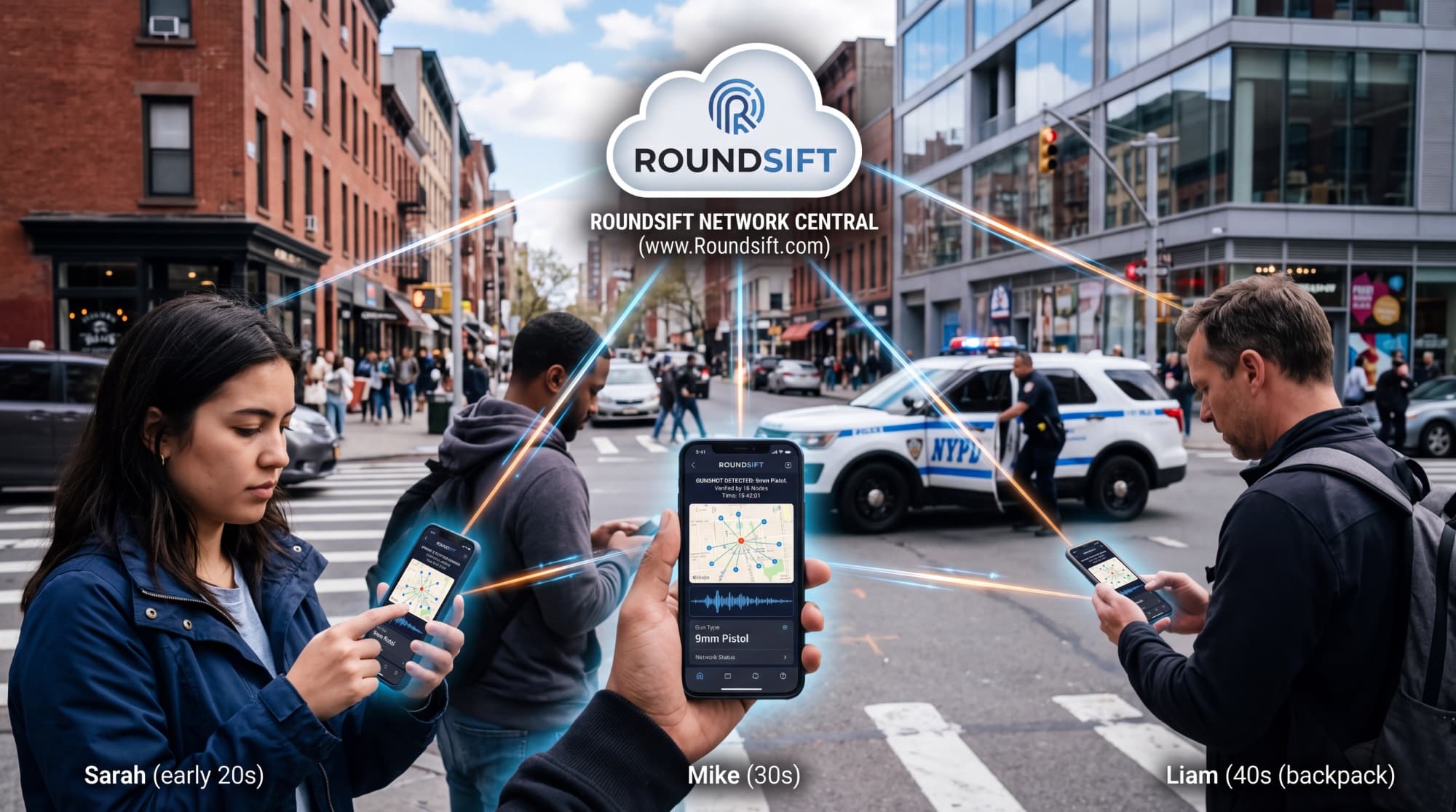
Nothing from your microphone leaves the phone until an acoustic fingerprint matches an impulse signature. Then nearby phones either confirm it — or don't. The short version:
On-device software listens for firearm-like acoustic impulse signatures.
Potential events are converted into acoustic characteristics locally on the device.
Nearby participating devices independently verify matching events.
Confirmed events create a structured, verifiable incident record.
On-device software listens for firearm-like acoustic impulse signatures.
Potential events are converted into acoustic characteristics locally on the device.
Nearby participating devices independently verify matching events.
Confirmed events create a structured, verifiable incident record.
Watch multiple participating phones independently detect and corroborate a simulated firearm event.
Illustrative simulation — not a real incident.
Event
Each RoundSift deployment shapes itself to the operating environment it's covering — the same pipeline, retuned to the kind of coverage that community actually has.
Cover neighborhoods and dispatch corroboration across blocks, beyond a paid sensor zone.
Instrument dorms, quads, and common areas — security gets a corroborating second look the moment an impulse is heard.
Line retail corridors and multi-tenant buildings with shared records, no new hardware.
Scale into planned communities and multifamily properties — coverage grows with each resident who opts in.
Cover hospitals and multi-building clinical sites with incident corroboration in the same record shape.
Stretch along rail, road, and right-of-way corridors — coverage follows the device, not the trench.
Four principles shape how RoundSift handles audio, location, and corroboration — so participating devices stay witnesses, not informants.
Acoustic analysis is designed to happen locally on participating devices.
Raw microphone audio is not continuously transmitted to RoundSift servers.
Location information is associated with relevant events rather than maintaining a continuous movement history.
Multiple participating devices can independently contribute evidence before an event is considered confirmed.
RoundSift is exploring pilot deployments with municipalities, campuses, property operators, public-safety organizations and technology partners.